
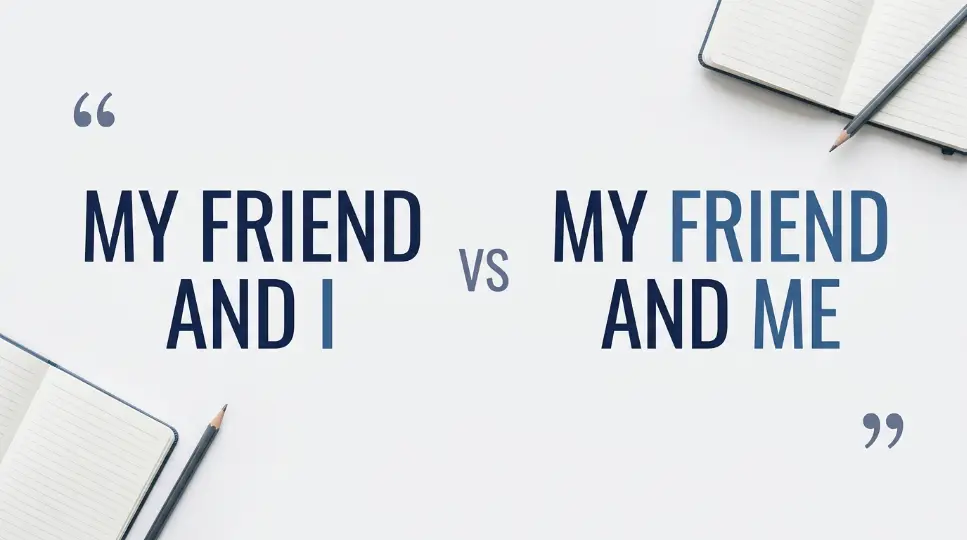
If you’re unsure whether to say “me and my friend” or “I and my friend,” the better choice usually depends on the role the phrase plays in the sentence. In standard English, “my friend and I” is normally used when the pair is the subject, while “my friend and me” is used when the pair is the object. “Me and my friend” is common in casual speech, while “I and my friend” sounds unusual in everyday English.
For example:
My friend and I went to the movies.
But:
The teacher spoke to my friend and me.
You may also hear “me and my friend” in casual conversation. It’s common in everyday speech, but it’s not the form you’d normally choose in formal writing when the phrase is the subject.
As for “I and my friend,” it isn’t the usual word order. Native speakers generally put the other person first: “my friend and I.”
When to Use “My Friend and I”
Use “my friend and I” when the two of you are the subject of the sentence.
In other words, you’re the people carrying out the action.
My friend and I went to the library after class.
My friend and I are planning a trip to Boston.
My friend and I finished the project yesterday.
My friend and I usually have lunch together on Fridays.
In each sentence, my friend and I are doing something: going, planning, finishing, or having lunch.
The same pattern works with other people:
My brother and I watched the game.
My coworkers and I discussed the new schedule.
My parents and I visited Chicago last summer.
You don’t need to think about a complicated grammar rule here. If I would work by itself, “my friend and I” will usually work too.
I went to the library.
So:
My friend and I went to the library.
When to Use “My Friend and Me”
Use “my friend and me” when you and your friend are receiving the action or appear after a preposition.
For example:
Sarah invited my friend and me to dinner.
Here, Sarah is doing the inviting. My friend and me are the people being invited.
More examples:
The manager spoke to my friend and me after the meeting.
She sent my friend and me the details by email.
The coach congratulated my friend and me after the game.
They picked my friend and me up at the airport.
The same thing becomes clear if you remove “my friend”:
Sarah invited me to dinner.
The manager spoke to me.
She sent me the details.
They picked me up.
You wouldn’t normally say “Sarah invited I” or “the manager spoke to I.” That’s why me belongs in these sentences.
What About “Me and My Friend”?
This is where everyday speech can make grammar feel confusing.
You will often hear people say:
Me and my friend went to the mall.
There’s nothing unusual about hearing this in casual conversation. People use the expression naturally when speaking with friends or family.
For formal or edited English, though, “my friend and I went to the mall” is the better choice.
The difference becomes especially relevant in situations such as:
- school assignments
- work emails
- applications
- professional writing
- articles and reports
So you don’t need to think of “me and my friend” as a phrase that never occurs. It’s better understood as a common informal construction that doesn’t fit the standard formal version of a subject.
Compare:
Casual conversation:
Me and my friend are getting coffee.
Formal or edited writing:
My friend and I are getting coffee.
The second version is the safer choice when you’re writing for a teacher, employer, client, or general audience.
Is “I and My Friend” Wrong?
Not exactly, but it sounds unnatural.
Consider this sentence:
I and my friend went to the concert.
The pronoun I is being used as a subject, so the basic case is not the problem. The awkward part is the order.
English normally places the other person before I:
My friend and I went to the concert.
That’s the version most readers and listeners will expect.
The same pattern appears in many everyday sentences:
My sister and I went shopping.
My colleague and I worked on the presentation.
My neighbor and I talked about the new restaurant.
You might technically understand “I and my friend,” but it doesn’t sound natural enough to be the preferred expression.
A Useful Test for “I” vs. “Me”
When you’re unsure, temporarily remove the other person from the sentence.
Take this example:
My friend and I went to the bookstore.
Remove “my friend”:
I went to the bookstore.
That works.
Now try:
The teacher called my friend and me.
Remove “my friend”:
The teacher called me.
That works too.
This isn’t a trick that solves every possible pronoun question, but for sentences involving “my friend and I” or “my friend and me,” it’s a handy check.
The mistake usually happens when people choose I because it sounds more formal, even when the sentence actually needs me.
For example:
The teacher gave my friend and I extra time.
That sounds formal, but the grammar doesn’t change just because the situation is formal.
The teacher gave me extra time.
So the natural version is:
The teacher gave my friend and me extra time.
“My Friend and I” or “My Friend and Me”?
A simple comparison makes the distinction easier to see:
| Phrase | Typical role | Example |
|---|---|---|
| My friend and I | Subject | My friend and I went home. |
| My friend and me | Object | She called my friend and me. |
You can also see the difference with a few common situations.
At school:
My friend and I studied for the exam.
At work:
The supervisor asked my friend and me to stay late.
At a restaurant:
My friend and I ordered pasta.
After the meeting:
The manager spoke with my friend and me.
The pronoun changes because its role in the sentence changes.
Common Mistakes to Watch For
One frequent mistake is choosing I simply because it seems more proper:
She invited my friend and I.
The correct form is:
She invited my friend and me.
Another is using me when the phrase is the subject:
Me and my friend went to class.
For formal writing:
My friend and I went to class.
And then there’s the less common “I and my friend.” It isn’t the usual way to arrange the phrase:
I and my friend went shopping.
A more natural version is:
My friend and I went shopping.
These three sentences look similar, but they involve slightly different issues. That’s why simply memorizing “always use I” or “always put me first” doesn’t work.
Why “My Friend and I” Sounds More Natural
English has a strong preference for putting the other person before yourself in phrases like these.
That’s why we naturally say:
My husband and I…
My sister and I…
My teacher and I…
My friend and I…
Rather than:
I and my husband…
I and my sister…
I and my teacher…
This is mostly about natural English usage and word order. It doesn’t mean that I can only appear at the end of a sentence. It simply means that in a coordinated phrase naming yourself and another person, the other person normally comes first.
What Should You Use in Formal Writing?
If you’re writing something for school, work, or a professional website, stick with the standard forms:
Subject:
My friend and I attended the meeting.
Object:
The organizer emailed my friend and me.
That’s clearer and avoids the casual construction “me and my friend.”
In conversation, you’ll still hear the informal version:
Me and my friend went there yesterday.
English changes slightly depending on the setting. Spoken language is often more relaxed than edited writing, so it’s useful to recognize both forms rather than assuming that anything you hear in conversation is automatically the preferred choice for formal writing.
The Bottom Line
For most formal and edited English, remember two forms:
My friend and I when you and your friend are doing the action:
My friend and I went to the concert.
My friend and me when the action happens to you:
The teacher called my friend and me.
You’ll also hear “me and my friend” in casual speech, and “I and my friend” is understandable but not the natural word order. When you’re writing something formal, “my friend and I” and “my friend and me” will usually give you the form you want.
Frequently Asked Questions
Is “me and my friend” grammatically correct?
It’s common in informal spoken English, especially when used as the subject. In standard formal writing, “my friend and I” is preferred for the subject.
Should I say “my friend and I” or “my friend and me”?
Use “my friend and I” when the phrase is the subject. Use “my friend and me” when it is the object.
My friend and I went shopping.
She called my friend and me.
Is “I and my friend” correct?
It can function grammatically as a subject, but it is an unusual and unnatural word order. “My friend and I” is the normal expression.
Can I use “me and my friend” in a text?
Yes. Casual texting and conversation are less formal, so you’ll commonly see or hear “me and my friend.” If the message is professional or formal, “my friend and I” is a better choice when the phrase is the subject.
Why do people say “my friend and I”?
English normally places the other person before the speaker in this type of phrase. That’s why “my friend and I” sounds natural, while “I and my friend” sounds awkward to most English speakers.
Leave a Reply